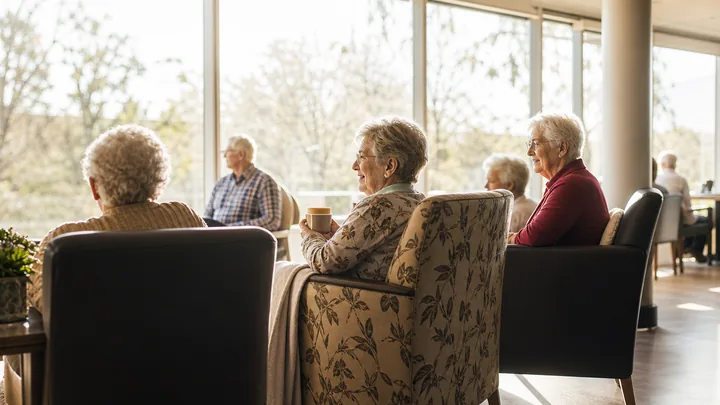
Some people living with dementia experience increased confusion or distress in the late afternoon or evening, often called sundowning, while others do not and timing varies. Changes in behavior can also signal pain, illness, medication effects, unmet needs, sleep disruption, or environmental stress and deserve individualized clinical assessment. A building cannot diagnose or cure the cause, but teams can observe patterns and adjust light, noise, activity, routine, and staffing as part of a documented care plan.
Where the evidence stands
The National Institute on Aging describes sleep and late-day behavior changes in Alzheimer's disease and recommends medical review of contributing conditions before relying on non-drug strategies. Evidence for specific environmental countermeasures is not definitive. The options below require individualized observation and care-team review; none is guaranteed or harmless for every resident.
Fight the dusk with the day
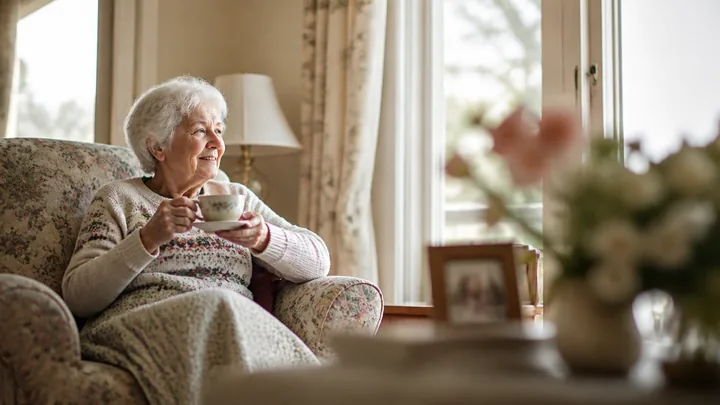
The environmental campaign starts hours before the trouble. A resident who has spent the morning in dim interior light, dozing in a lounge chair, arrives at four with a flattened circadian signal and a full tank of unspent restlessness: the perfect sundowning candidate. The countermeasures are the unit's daytime habits: real morning light (breakfast near east glazing, the bright honest daytime scene, time outdoors or at the window as routine, not treat); real morning occupation (the workroom's purposeful hours, the walking loop's mileage) so the afternoon's fatigue is earned rather than accumulated as static; and a lunch hour that doesn't tip into a two-hour post-meal void of parked wheelchairs and daytime television: the void is where the wave gathers. Units that treat 9-to-2 deliberately report gentler 4-to-6; that correlation is practice lore, but it runs in the only direction the biology suggests.
Hold the light up as the sun goes down

Review the late-day visual environment as one possible contributor. Reflections, glare, deep shadows, or abrupt changes may trouble some residents and not others. Adjustable shades and lighting scenes can be tested, but levels and timing should be chosen with the care team and a qualified lighting professional so glare, sleep, resident preference, accessibility, and life safety remain in balance. Record the individual response rather than treating a preset as a universal intervention.
Give the wave somewhere to break
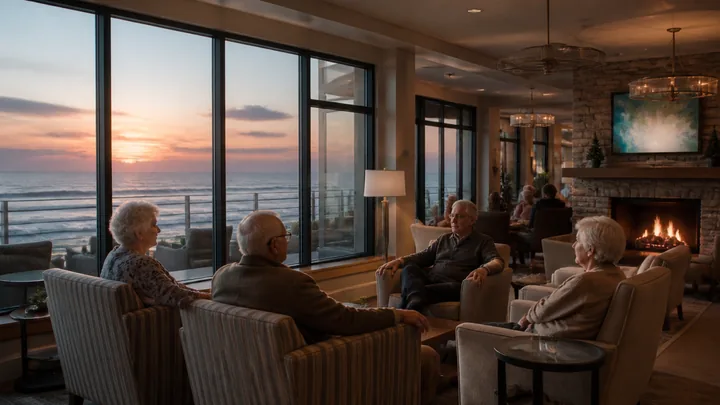
Sundowning is kinetic; the plan should route the energy rather than dam it. The walking loop is the primary channel. A restless resident with a good circuit is exercising; the same resident in a dead-end corridor is escalating. Load the loop's late-afternoon stations deliberately: the workroom task that suits agitated hands (folding, sorting, winding), the garden door open while light lasts, the snack point: hunger and thirst are quiet sundowning amplifiers, and a visible plate of something beats a med-pass response. In parallel, protect the opposite pole: the quiet room held ready, not booked, not cluttered, for the residents whose wave breaks inward, offered preventively at each one's known hour. And mute the unit's own contributions to the storm: shift change performed away from resident space (the lobby parade of departing staff is a mass demonstration of leaving at the worst possible hour), housekeeping's machines banished from the afternoon, deliveries done by three, the television's alarms and arguments nowhere in earshot.
Staff geography is environmental design
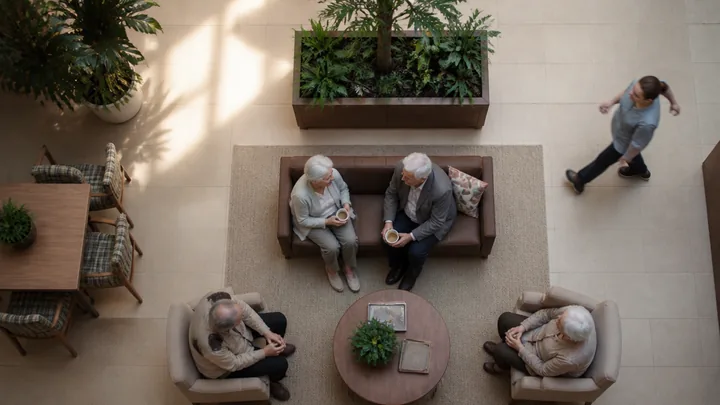
Where bodies stand is a design layer as real as walls. The sundowning hours want staff distributed and visible (at the hearth, in the workroom, walking the loop) rather than clustered at a desk doing handoff; a uniformed presence in each gravity room steadies the weather by existing. This is an argument for handoff formats that keep one anchor person in the shared space, for charting stations embedded in the household (the kitchen counter, the hearth-side desk) rather than a fortress station, and for scheduling that overlaps shifts across the peak instead of splitting at five o'clock sharp, rostering decisions, but the floor plan votes: a unit whose only work surfaces are in a back office will pull its staff backstage at exactly the hour the stage needs them.
Dinner in the trough
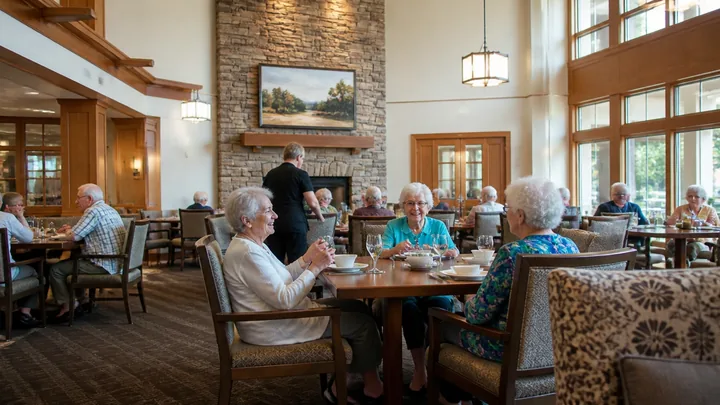
Dinner can coincide with late-day distress, so teams can test a calmer arrival, manageable sound, suitable lighting, and optional familiar tasks for residents who enjoy them. The environment may contribute, but no defensible percentage can be assigned and behavior should not be assumed environmental without assessment. Track what happens for each resident and revise the plan with clinical staff.
The family collision
Visiting hours and sundowning share an afternoon, and the collision is predictable: the daughter arrives at four, the visit sours by five, the goodbye detonates at the door. Environment and scheduling can both soften it: a visit room off the main flow so departures don't cross the hearth, the coffee-and-task ritual at goodbye time described in the doors article, and honest coaching for families: morning visits find your person at her best; if afternoons are what you have, plan a walk on the loop or a job at the workbench rather than a sit-down conversation as the light fails. Families told the pattern's name and schedule stop reading it as decline-since-Tuesday, which is its own mercy.
The audit
Chart a month of incident and PRN times against the clock, and most units will draw the wave themselves. Then walk the unit at three-thirty as a stranger: how bright is it, really: measure, don't recall; where are the shadows and the black glass; who is doing anything; where is the staff; what does the loop offer a fast walker; is the quiet room ready or full of boxes? Set the countermeasure clock (light up at three, blinds before dusk, snack at four, quiet-room offers by name, handoff off-stage) and run it for a season. The wave will still come; it is weather. But weather is what buildings are for, and a unit arranged against the afternoon returns its hardest hours, partly, to the people living through them.
Sources and scope
These primary and research sources anchor the subject area; they do not turn every design recommendation in this article into a proven outcome. Verify current law, adopted code, licensing rules, care plans, and clinical requirements for the specific property.