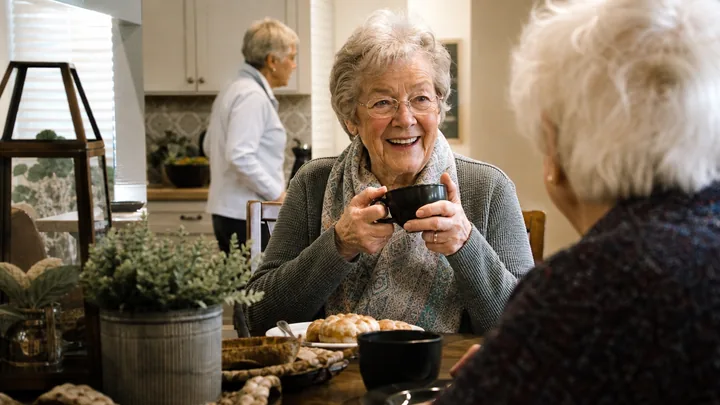
Here is an uncomfortable structural fact about senior living: the person who chooses the building usually will not live in it. Adult children shortlist the communities, book the tours, read the reviews, and heavily influence, often make, the final call. The resident's opinion matters enormously; the daughter's opinion usually decides whether the resident's opinion is ever asked.
This means your common areas are performing for two audiences at once. Residents experience the building across thousands of hours. Families judge it in perhaps ninety minutes (a tour, a couple of visits) and generalize ruthlessly from what those minutes contain. Call it the family-tour effect: the spaces visitors see carry a weight in your occupancy economics far out of proportion to the time anyone spends in them.
What families are actually asking
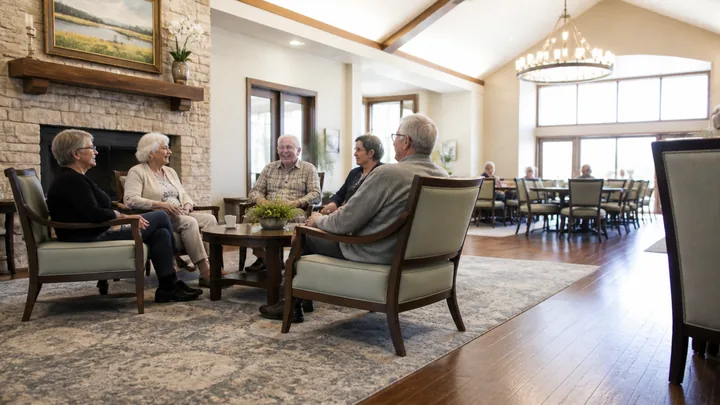
A touring family is not evaluating architecture. They are answering one question: can I imagine Mom here, and can I live with myself if the answer is yes? They answer it with proxies, because they lack the expertise to evaluate care directly. The proxies are mostly environmental:
- Smell, first and instantly. Nothing on a tour outruns the entrance's first breath. An odor problem is read, fairly or not, as a care problem, and no chandelier recovers from it.
- What the residents are doing. A lounge where residents are engaged (talking, playing, working on something, asleep in the sun with a book) reads as life. A row of wheelchairs parked facing a television, or facing nothing, reads as warehousing, and families remember it verbatim.
- How staff and residents interact in passing. Families watch the interactions the tour didn't stage: does the aide crouch to talk, use names, knock before entering? The common areas are where these unscripted moments happen in view.
- Whether the building is honest. Visitors notice when the lobby is a set piece and the corridors behind it decline in finish, light, and upkeep. The gradient itself is the message: money goes where visitors look. Sophisticated families tour past the lobby on purpose.
Where the evidence stands
That first impressions and physical environment shape institutional trust is well-trodden ground in consumer research generally, and the central role of adult children in senior-living decisions is standard industry knowledge. The specific proxy list above is our synthesis from operational experience and common practice, not a validated instrument. We are confident in the direction; we have not measured the weights, and we distrust anyone who claims to have measured them precisely.
The trap: designing for the tour instead of the resident
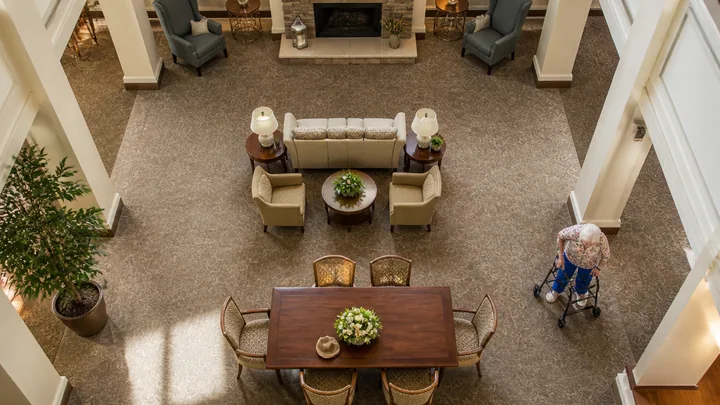
Taken naively, the family-tour effect argues for theater: a grand lobby, a show kitchen, a bistro that photographs beautifully and sits empty. This is the most common strategic error in the sector, and it fails on its own terms, for two reasons.
First, families can tell. An empty beautiful room testifies against you: if the bistro were part of real life here, there would be residents in it. The most persuasive space on any tour is an ordinary room being used hard by people who chose to be there. Occupied beats opulent, every time, and you cannot stage occupancy three tours a day.
Second, the tour is not the last visit. The same daughter comes back Tuesday evenings for years. Post-move-in, her proxies sharpen: is Dad out of his room? Is he clean, engaged, known by name? Is the dining room somewhere she would eat? Family visitors are your most persistent quality auditors, and their ongoing verdict drives reviews, referrals, and whether the family fights a discharge or requests one. A building designed only to tour well eventually gets re-graded by people who now know better.
The resolution of the trap is convenient: the same investments serve both audiences. A dining room with good acoustics, usable chairs, and genuine social life tours magnificently, because it is real. Design for the resident's Tuesday, and the tour takes care of itself.
Spaces that serve the visit itself
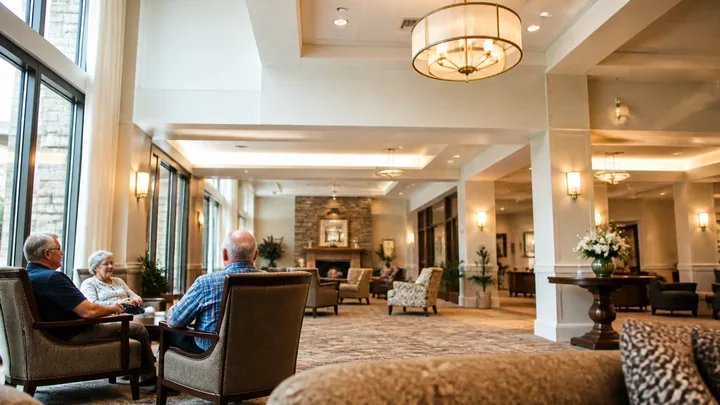
One family need is genuinely distinct: somewhere to be together. Visits fail in buildings that offer only two settings: the resident's room (small, private, sometimes shared) and the main lounge (public, loud, no intimacy). Design for the visit:
- Small conversational settings (alcoves, window bays, a pair of chairs and a table off the main path) where a family can talk without an audience. Semi-private beats private-room and beats grand-hall for most visits.
- Something to do. Conversation with a parent in cognitive decline is hard to sustain cold. A puzzle in progress, a cart of picture books, a piano, a garden to walk, coffee to fetch and pour: shared activity is the visit's scaffolding, and the building can supply it.
- Grandchild gravity. If visiting grandchildren have nothing to do, visits shorten and thin. A basket of toys, a lawn where running is allowed, cookies at reception: small accommodations that lengthen visits, which residents feel directly.
- A dignified place for hard conversations. Families also come for care conferences and bad news. A bookable quiet room with a door, tissues, and no fluorescent hum is common-area infrastructure too.
Managing the gradient
Audit your building the way a skeptical daughter does. Start at the parking lot, phone in hand, and walk to the farthest common area a visitor might plausibly reach. Note where finish, lighting, cleanliness, and odor change. That line, wherever polish gives way to institution, is where your credibility ends, and every family finds it. You may not afford to erase the gradient at once, but you can choose where the money goes next: usually not another lobby refresh, but the corridor and lounge one ring further in. Our piece on renovating occupied buildings covers the how.
Principle vs. proven
Solid ground: families weight environmental first impressions heavily; visit quality depends on having somewhere comfortable to visit; visible resident engagement is persuasive. Working judgment: the claim that resident-first investment outperforms tour theater on occupancy over time. We believe it, we argue it above, and we note honestly that it is a judgment about long-run reputation, not a measured result we can hand you.
Between the tour and the Tuesday: the move-in month
One more window deserves design attention: the first month after move-in, when the family's judgment is rawest and their guilt is loudest. This is when a daughter decides whether the choice was right, and she decides it in the common areas: did someone introduce Mom at dinner, is there a chair that has become "her" chair, does staff greet her by name in the corridor? Operationally cheap moves carry enormous weight here: a standing table invitation for the first week, a named host among the residents, a photo of a new resident's first coffee group sent to the family. None of this is architecture, but all of it happens in the architecture, and a building with warm, legible, small-scaled social spaces makes every one of these gestures easier to perform and easier to see. The family-tour effect does not end at the deposit; it compounds or curdles in month one.
The honest conclusion
The family-tour effect is real leverage, but its deepest lesson is not about staging. It is about alignment. Families are, in the end, trying to see through the building to the care. The building that has nothing to hide, where the show space and the lived space are the same space, wins the tour and the Tuesday visit and the online review with a single investment. Judged by people who don't live there, the best strategy is a building built entirely for the people who do.
Sources and scope
These primary and research sources anchor the subject area; they do not turn every design recommendation in this article into a proven outcome. Verify current law, adopted code, licensing rules, care plans, and clinical requirements for the specific property.