Give each surface a defined job
Ask the activities and care teams how the room is used now. Distinguish a place for personal items, a shared display, a visitor's drink and a surface where people will work together. One decorative coffee table should not quietly become the default for all four jobs.
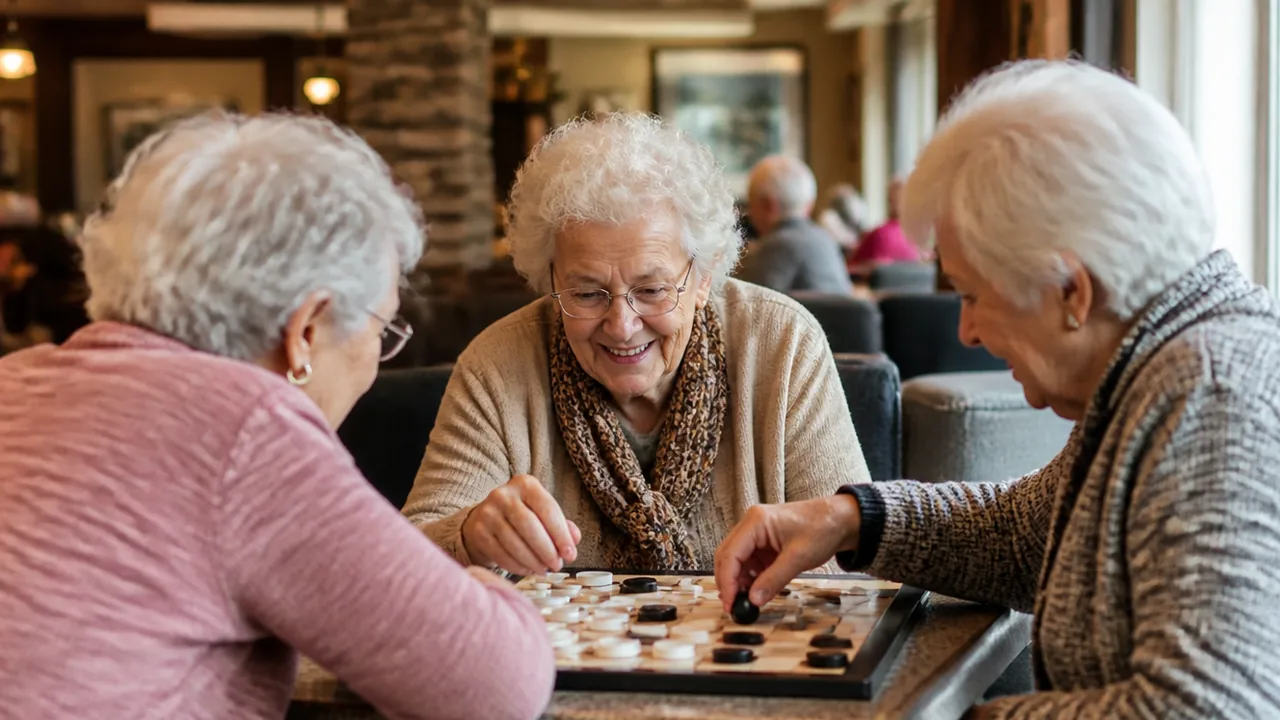
Record the actual objects: the puzzle board, tray, books, craft materials or game used by the community. Measure them in the arrangement needed during the activity, rather than stacked for storage. Include the space staff need for setting down and retrieving items. Ask which objects can sit on a separate surface and which must remain together.
This is a furniture-use brief. Individual seating, support and assistance remain part of the community's care process. A table advertised for senior living does not establish that it suits every resident or activity.
Check the arrangement, not only the area
Draw the required objects to scale on the proposed top, or place paper outlines on a full-size sample. Outside table dimensions may include edges or other details that do not provide the flat usable surface you need. Ask the supplier for that usable area.
Consider a hypothetical rectangular puzzle board 24 inches by 18 inches and an 8-inch-square tray. Their combined area is 496 square inches. A 24-inch-square top has 576 square inches, so an area-only comparison appears to pass.
The arrangement still fails if both objects must lie flat, parallel to the table edges, without overlap or overhang. The board occupies the full 24-inch dimension in one direction, leaving a strip only 6 inches deep in the other. The 8-inch tray cannot fit in that strip. Rotating the board through 90 degrees produces the same conflict.
| Object or surface | Dimensions | Area |
|---|---|---|
| Puzzle board | 24 × 18 inches | 432 square inches |
| Tray | 8 × 8 inches | 64 square inches |
| Combined objects | Separate objects that must both fit | 496 square inches |
| Proposed square top | 24 × 24 inches | 576 square inches |
That example tests only the stated edge-aligned arrangement. It does not rule out every rotated arrangement or establish adequate space for hands, drinks and normal use. For the actual activity, draw the needed placement and handling space rather than using total area as the buying criterion.
Separate occasional tables from activity surfaces
Ask the supplier to identify the intended use of each candidate. An end table, coffee table and activity table may coordinate visually while serving different positions in the room. Compare their actual top dimensions, height, base and approved use separately.
Kwalu's Jensen brochure, for example, identifies separate coffee and end tables and describes Protea Fusion and solid-surface top options. Those product-family choices show why a collection name alone leaves questions open. Obtain the current reference and dimensioned specification for the exact table and top offered; the example is not a recommendation for the community's activity.
If the activity needs people to sit at the surface, have the responsible team assess a table intended for that use. A broad coffee-table top does not by itself provide an appropriate seated working position. Do not prescribe one height, reach distance or knee clearance for every resident from this comparison.
Review the occupied arrangement
Place the proposed table with the actual accepted seating and the objects it must hold. Check the approach, base position, neighboring furniture and space for the usual support or mobility equipment. Keep access to the shared activity visible; an object fitting on the far side of a top does not show that a person can use it there.
Start with the staff arranging the objects. If resident participation is useful, arrange it through the community's usual care and consent procedures, with normal support and assistance. No one should attempt an unfamiliar reach or transfer to demonstrate that a purchasing choice works. The care team decides what participation and support are appropriate.
Use the common-area accessibility review to refer layout questions to the responsible project professional. This activity check does not certify the room or replace individual care assessment. Record furniture and object findings in the buying file; keep resident information in the community's appropriate records.
Include resetting and care in the choice
Agree what happens when the activity finishes. Identify where its materials are stored, whether the table stays in place and who resets the seating. If the table must move, obtain the manufacturer's permitted handling method and review the actual route with the responsible staff. Do not assume a large surface can be shifted by one person because it looks light in a photograph.
Send the supplier the cleaning products and routine used in the room. Request instructions for the selected top, edges, base and attachments. Different top options within one collection should have their own applicable care information; a general easy-clean claim cannot answer every compatibility question.
Ask what staff should do if the top, edge or base is damaged. Keep the supplier contact and exact reference with the furniture record so the team can obtain an approved response.
Request a table for a clear use
The buying brief should show the activity, object dimensions and proposed placement, the accepted seating, room plan and any open access or care questions. List the exact table and top option when one has been reviewed. If the supplier proposes another model, repeat the usable-surface and occupied-arrangement checks before accepting it.
Count tables by the activities that must run at the same time, including the usable tables already owned. Keep an occasional drink surface separate from a shared activity table in that count. Otherwise a room can appear fully furnished while its regular activity still has nowhere suitable to take place.
Use the furniture planning checklist to retain the chosen references, quantities, delivery details and unresolved supplier questions. The useful result is a table assigned to a real job, with its fit and care decisions recorded.
Sources and scope
These primary and research sources anchor the subject area; they do not turn every design recommendation in this article into a proven outcome. Verify current law, adopted code, licensing rules, care plans, and clinical requirements for the specific property.